From the beginning of mankind, man tried to find a way to store information for the following generations. When people nowadays hear the word storage or computer storage they normally think aboutCD Rom, USB key or DVD. Things like the floppy disk or the punch card are nearly forgotten. In fact, the history of information storage goes back to pre-historic times where mankind used red and yellow ochre, hematite, manganese oxide and charcoal to paint information about their life on rock walls, caves and ceilings.
Nowadays we are used to having hundreds of gigabytes of storage capacity in our computers. Even tiny MP3 players and other handheld devices usually have several gigabytes of storage. This was pure science fiction only a few decades ago. For example, the first hard disk drive to have gigabyte capacity was as big as a refrigerator, and that was in 1980. Not so long ago!
Pingdom stores a lot of monitoring data every single day, and considering how much we take today’s storage capacity for granted, it’s interesting to look back and get things in perspective.
Here is a look back at some interesting storage devices from the early computer era.
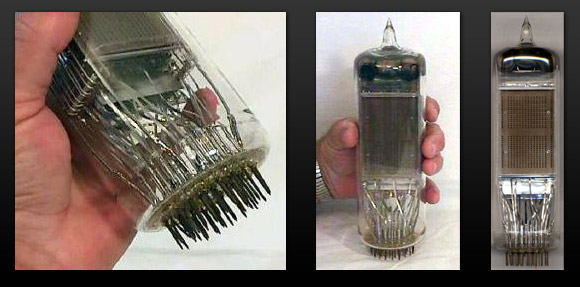
The Selectron tube
The Selectron tube had a capacity of 256 to 4096 bits (32 to 512 bytes). The 4096-bit Selectron was 10 inches long and 3 inches wide. Originally developed in 1946, the memory storage device proved expensive and suffered from production problems, so it never became a success.
Above: The 1024-bit Selectron